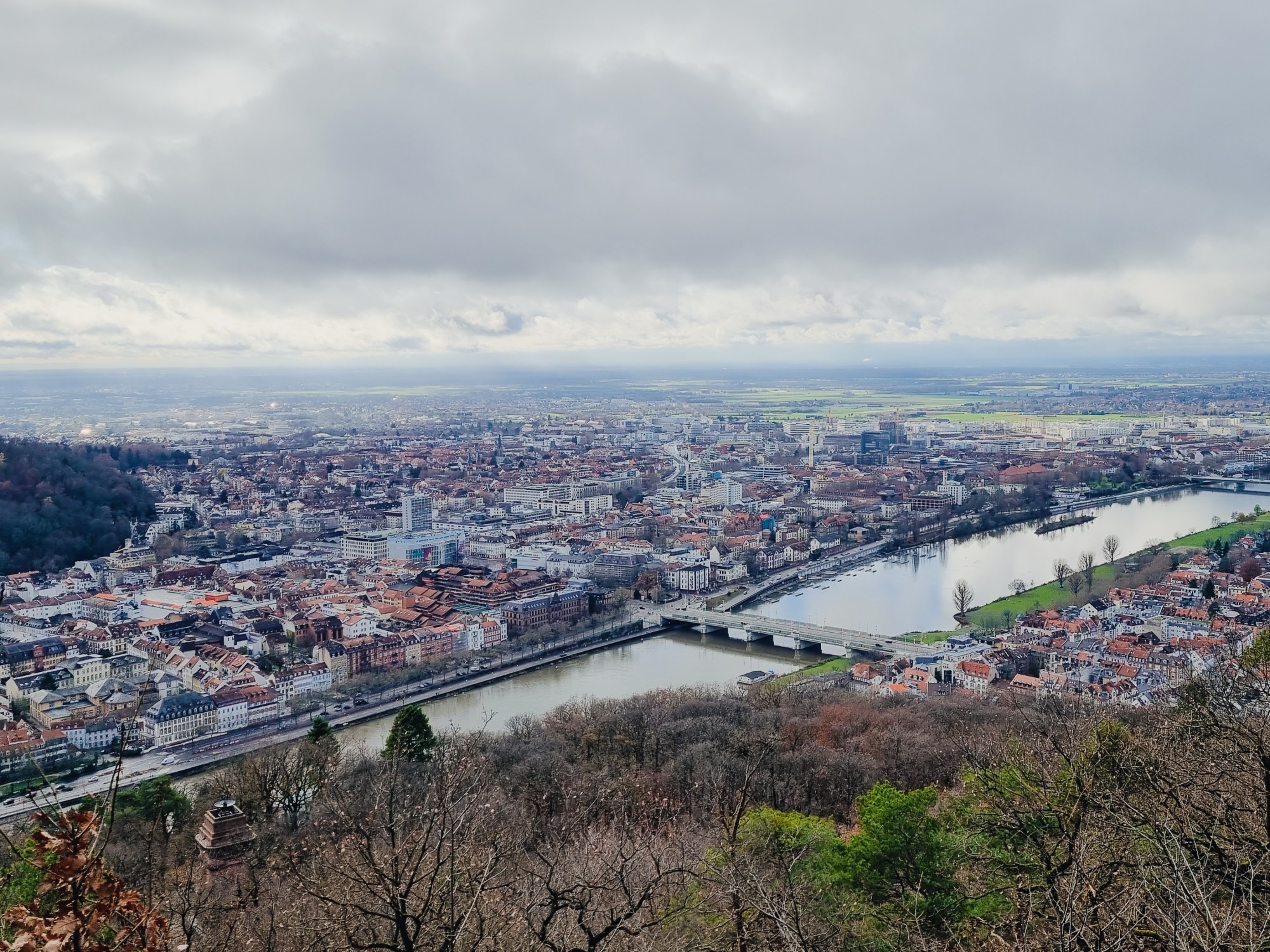
Heidelberg a city with dreamy, romantic settings from Old Bridge to the castle on a mountain viewable right from the old city center. This city is a blend of both the old and new with a modern shopping street filled with trendy brands on one end and historical sites with castles and magical gardens dating back to 1200s that was once part of the Holy Roman Empire. All of these attractions are nestled between the Neckar River and the foothills of the Odenwald forest.
If you’ve been following my 4 days 3 night stay in Heidelberg and you’re looking to visit soon 👉No worries, I got you! summed up below is the exact attractions I visited below.
But first up, I’d like to share with you where I stayed in Heidelberg – I can’t rant enough about how lovely, spacious and clean this Airbnb apartment stay was. On top of this, it was convenient to get into the city in just 20mins walk and there are tram and buses well connected to Old town too.
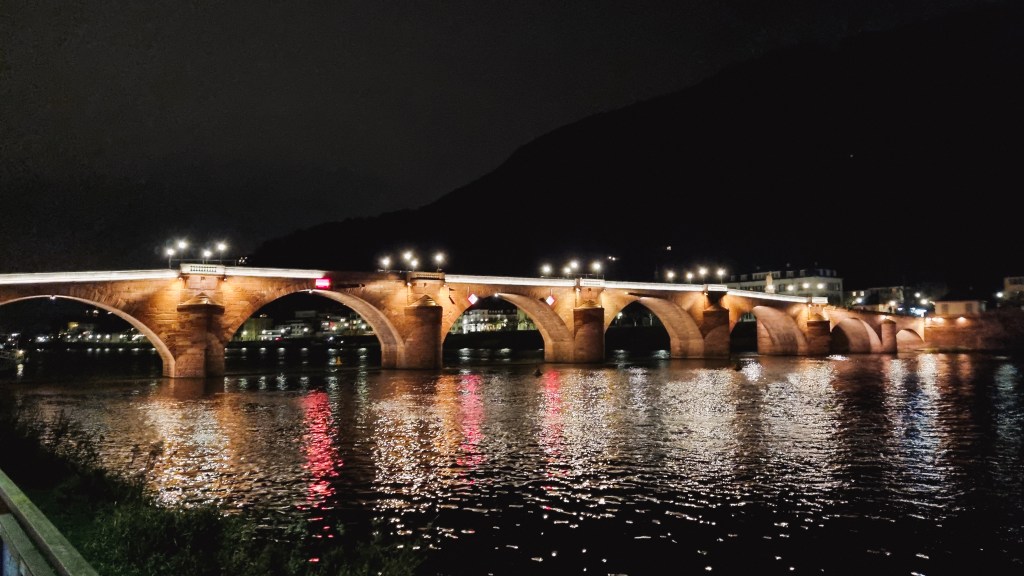
Alte Brücke
Built of Neckar valley sandstone in the 18th century by Prince Karl Theodor, the famous Old Bridge (Alte Brücke) is one of the last classical stone bridge building. It links the old town to the banks of the Neckar. The precursors of today’s Old Bridge were all made of wood and they were continually being destroyed by wars and floods, Prince Karl Theodor ordered the construction of a stone bridge across the river (1786‑1788). On the city side is the medieval Bridge Gate, part of the former city wall

Heidelberg Bridge Monkey
West of the Bridge Gate, try and spot this little creature, the Heidelberg Bridge Monkey holding a mirror up to those who look at it. The bronze sculpture by Professor Gernot Rumpf was installed there in 1979. But there was a bridge monkey in Heidelberg as far back as the 15th century.
The legend surrounding this curious statue tells us that it symbolizes the fact that neither the city‑dwellers nor the people who lived outside the city were better than the other, and that they should look over their shoulder as they cross the bridge to remember this.

World‑famous German Romanticism – Heidelberg Castle
The castle ruins rise majestically over the roofs of the old town, but for five hundred years it was home to the Prince Electors of the Palatinate. Pre‑pandemic, the enigmatic castle attracts several million tourists. One of the unique characteristics of the castle is that different parts of the architecture were built across different periods of time resulting in a castle constructed in a variety of styles from Gothic to Italian Renaissance to English influences.

Hall of glass
The Hall of Glass is located between the Friedrich Building and the Ottheinrich Building. Constructed by Prince‑Elector Friedrich II, who ruled between 1544 and 1556. At this point, Germany was still part of the Holy Roman Empire. Friedrich II had the facade segmented by arcades in the style of the Italian Renaissance. The building was named for its magnificent second‑story hall, once adorned with Venetian mirror glass

A palace for a princess
When Heidelberg was ruled by Prince‑Elector Friedrich V, the prince married Princess Elizabeth Stuart, daughter of King James I of England, in 1613. To provide a suitable residential palace that would remind his regal wife of home, he built a new structure outside of the actual palace, along the north wall. Today what’s left of the English Building is only a standing facade with windows framing the blue skies. The roof was lost in the destruction of the war in the 16th century as well as palace fires of 1764. The few remnants of stucco decor along the window jambs of the ruins demonstrate how lavish the decor once was.

Repairing the castle in 1900s
The Ottheinrich building is one of the most beautiful and oldest palace structures of the German Renaissance with stately sculptures adorning the facade while the Friedrich Building is the gorgeous residential end of Heidelberg Palace. Within the residential halls the interiors are completed in luxurious finishings and also houses the romantic palace chapel thats a favourite for weddings.
Both buildings were damaged during war by fire in the 1600s and it wasn’t until 1893 that the Baden government commissioned an architect and regional artists to recreate the ornamented wooden ceilings and floors in the Renaissance style. Walk out onto the Great Terrace and it offers a fantastic view of Heidelberg’s historic district.

German Apothecary Museum
A fascinating walk through the exhibition in the basement of the Ottheinrich Building shows how the healing powers of nature were used in the Middle Ages and Early Modern Age. The German Apothecary has been set up in the basement since 1958. Besides substances originating from plants, an assortment of curiosities are hidden among the approximately 1,000 remedies. Take note the opening hours of the apothecary differ across the year 👉 10am to 540pm in Apr to Oct and in Nov to Mar, 👉10am to 510pm. We missed out on seeing this amazing section of the castle as closing time was earlier than expected
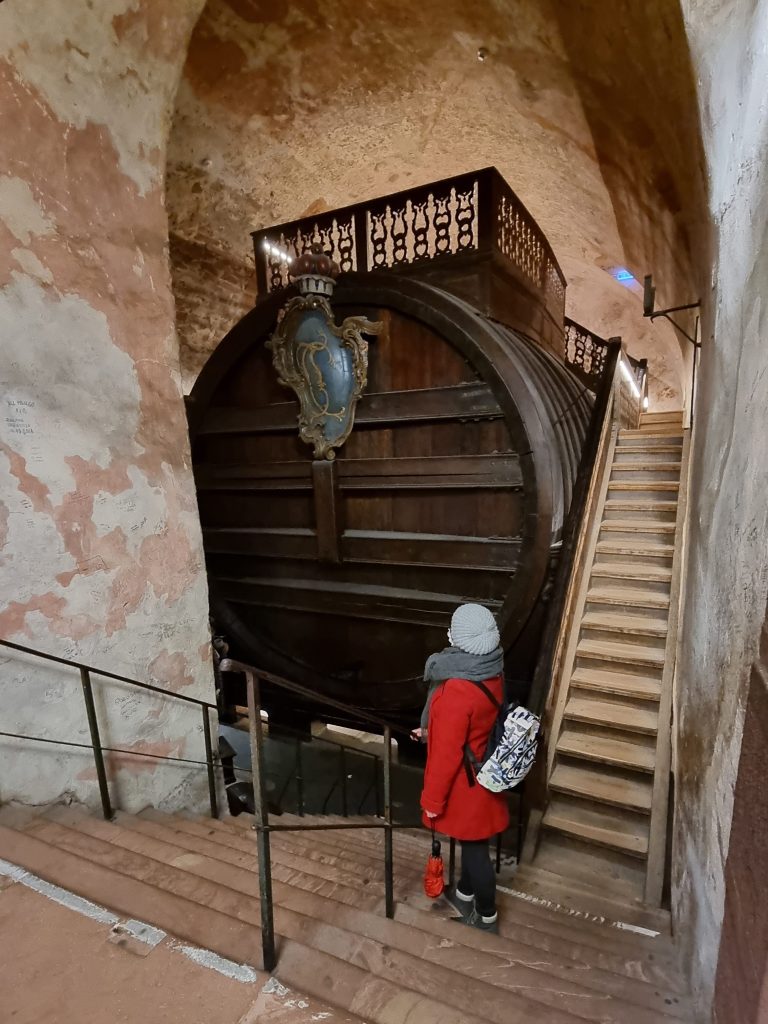
The Great Barrel
An original Great Barrel holding 130,000litres of tithe wine fell victim to the turmoil of the Thirty Years’ War. In 1664, it was replaced by an even larger barrel with 200,000 liters capacity. Nearly 100 years later, Prince‑Elector Carl Theodor, who had long since taken up residence in Mannheim Palace, had the third and current Great Barrel constructed. 220,000 liters of wine were stored here. An interesting detail of the barrel is a staircase that leads to a platform above the barrel which was likely used as a dance floor.
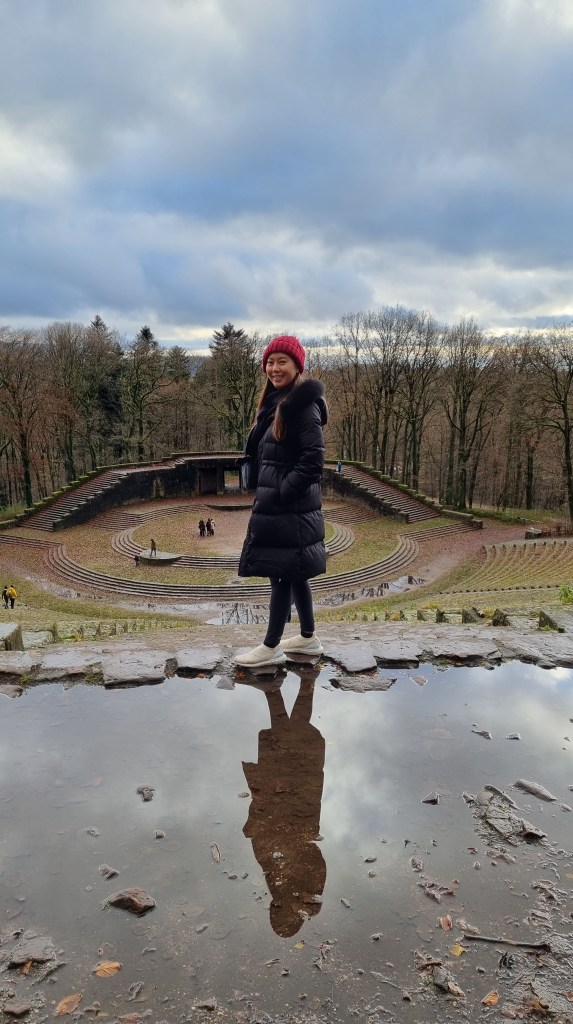


Heiligenberg a holy mountain
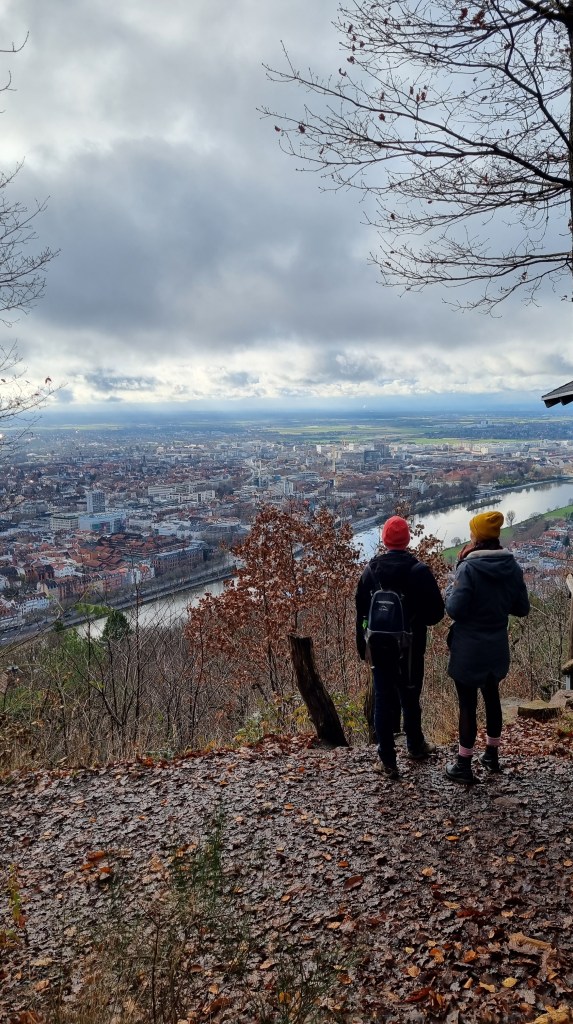
On the North banks of the river Neckar you can see the silhouette of the Heiligenberg with a height of 440 m with sweet townhouses on the slopes of the mountain. The Philosophenweg (philosophers’ walk) thats at its foot offers gorgeous viewpoints of Heidelberg with a garden filled with exotic plants and vegetables.
Head to the top, I highly recommend this as the views only get more stunning. It’d take roughly an hour to reach the peak and you’d come across Thingstätte, an amphitheater dating back to the Nazi period which one of Hitler’s closest acolytes, Paul Joseph Goebbels addressed 20,000 people during its opening. These days it’s used mostly for theatre or cultural events. Following the foot path 200 m to the second peak of the hill, there is a piece of history that is really worth seeing: the ruins of the Abbey of St Michael that goes back to 800s during the Roman Empire. From here, there is a sweet cottage restaurant serving food & coffee if you get hungry or you can search out clearings in the trees where an impressive view over the Neckar valley is easily spotted.

The Neuenheim district
Located at the foot of the Heiligenberg opposite the old town, is connected to Heidelberg city center by a Neckar bridge. Neuenheim’s central axis and shopping street is Brückenstraße. Here you will find magnificent houses in which small but fine shops alternate. The diversity of the offer around the Brückenstraße is impressive: high‑quality and unusual fashion, jewelry, perfume, flowers, trends in home decor, toys, books, sporting goods, galleries and much more.
This is also where we enjoyed our high tea after our Sunday hike at River cafe where the wine, cakes & tartes were lovely. I’ve marked down the location of River cafe below so it easy for you to find when you go for your hike.
Karlsplatz of the city center
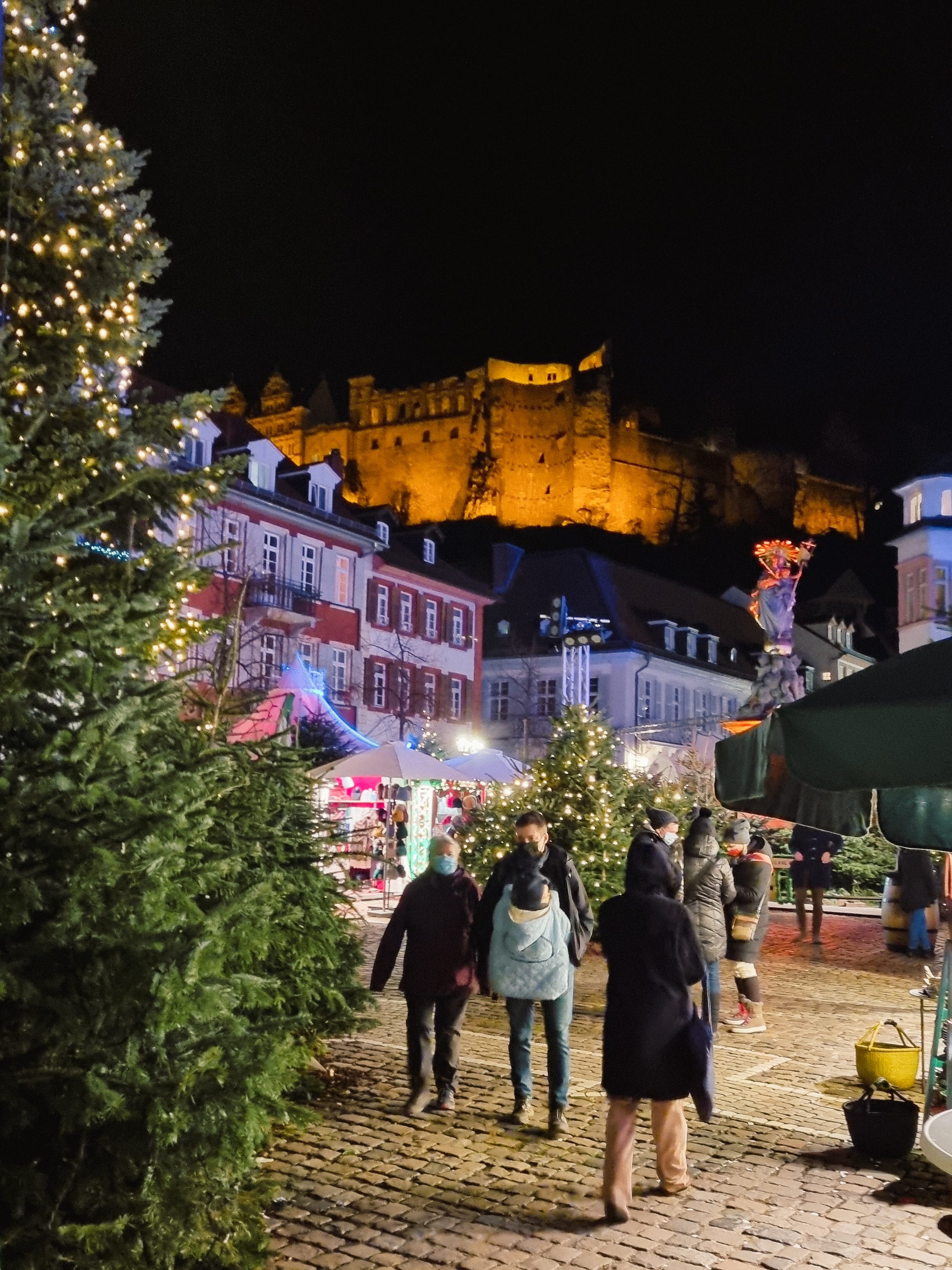
The Karlsplatz, named after Grand Duke Karl Friedrich von Baden, extends over the area of the Franciscan monastery, which was laid down in 1803. The square, opens up an unobstructed view of the castle and is located directly on the main street. One of the attractions of the Heidelberg Christmas Market is the open air ice rink on Karlsplatz at the foot of the castle.
Thank you for reading about my travels through Heidelberg! I must say this city along with its generous amount of nature was really a treat during our trip through North France and Germany
With the pandemic still ongoing, it’s amazing how the world has now adapted to a new way of travelling – the vaccination route.
To avoid unpleasantries along the way, I recommend every traveler to do your travel restriction research before setting off to your destination. Some items on your to-do checklist before setting off are:
- Notarise your vaccination status so you can carry your vax certification around with you at all times.
- Buy your travel insurance in case of emergencies while travelling.
- Carry a good supply of masks and sanitisers for your trip. In some countries, only surgical masks are recognised for usage so it’s crucial to do some read up.
- When we visited Germany in Dec 2021, locals were really kind to inform us about daily antigen tests required for all tourists heading out each day for activities. We were lucky enough that the first couple of days, antigen tests were all free of charge however on the 5th day, restrictions set in that tourists had to pay 29 euros per test so again always do your research to prevent breaking the bank while travelling in covid times.

 Traveler Gwen Eats